
The key concepts
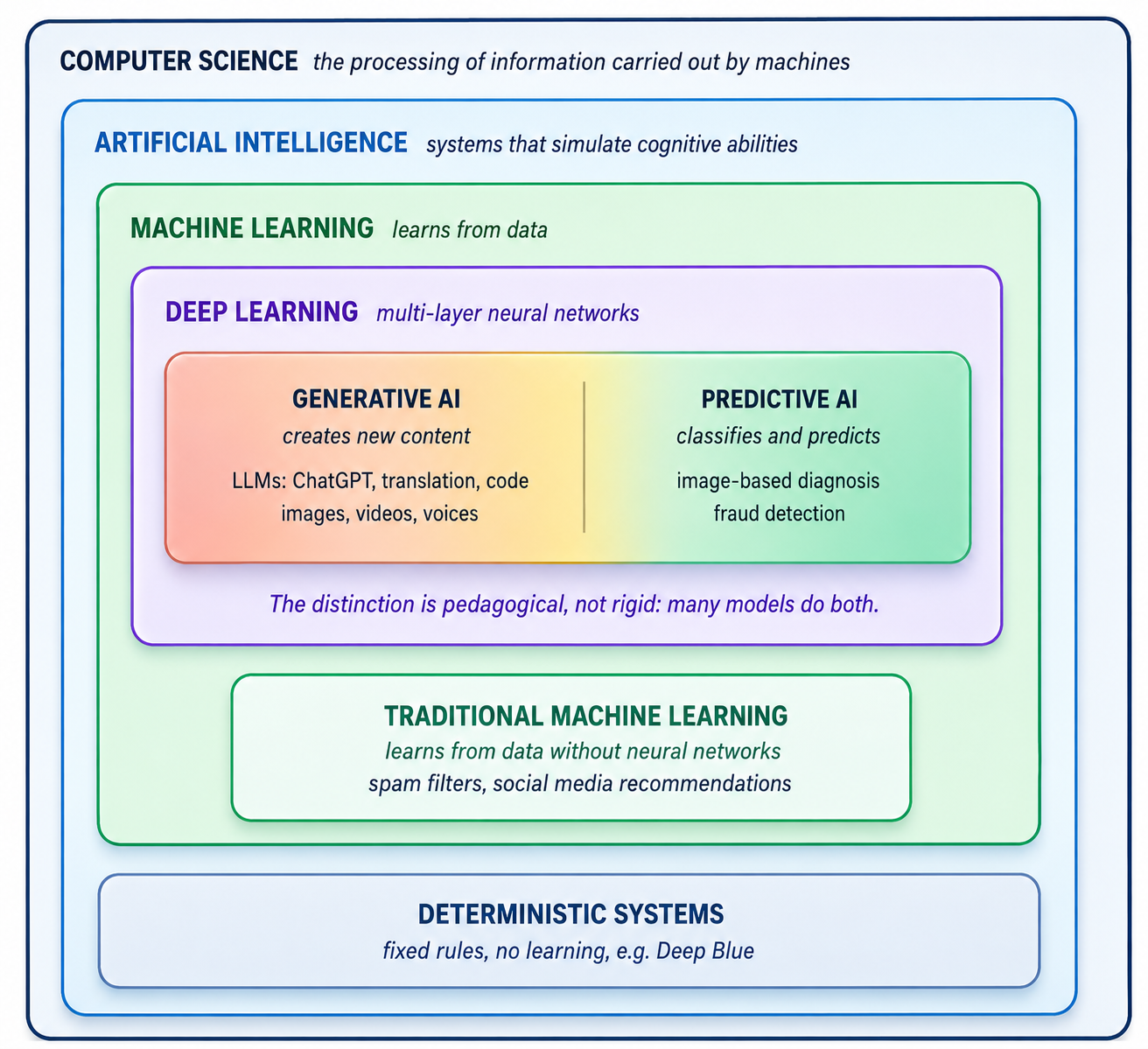
The chart presents some of the key terms and concepts to know, and frames artificial intelligence as one of the branches of computer science (the others are not shown). Like all representations, this chart has its limits: the boundaries aren’t always so clear-cut, and the definitions, for obvious reasons, are incomplete. I hope the experts will forgive me.
The first major divide within artificial intelligence is between deterministic systems and machine learning. Deterministic systems are what you usually think of when talking about a computer program: hand-written rules that produce predictable flows (“if this happens, do that”). Same problem, same answer.
Machine learning (ML) works the opposite way: no one writes the rules. The machine works them out on its own, by observing mountains of examples. It doesn’t follow a fixed recipe, it reasons in terms of probability. This is the difference that explains, later on, why today’s AI sometimes “gets it wrong” or changes its answer: it isn’t following rules, it’s estimating what’s likely.
Machine learning isn’t a new concept, but it’s with the arrival of neural networks with many layers (deep neural networks) that it became the basis of the AI revolution. Within machine learning, in fact, the technique that changed everything is deep learning: the set of methods used to design, train, and use these deep neural networks.
Deep learning today does two things. It predicts: it recognizes a tumor in an X-ray, discovers the shape of a protein, decides which video to show you. And it generates: it creates new content, text, images, videos, voices. This second part is generative AI, and it’s the real focus of this course.
It’s not shown in the chart to avoid overloading it, but transformers deserve a mention, a type of deep neural network whose architecture uses attention mechanisms to relate the elements of the input to one another.
LLMs, to simplify, are deep neural networks of the transformer type that, in their simplest form, learn to predict the most likely next word, based on the text received up to that point.